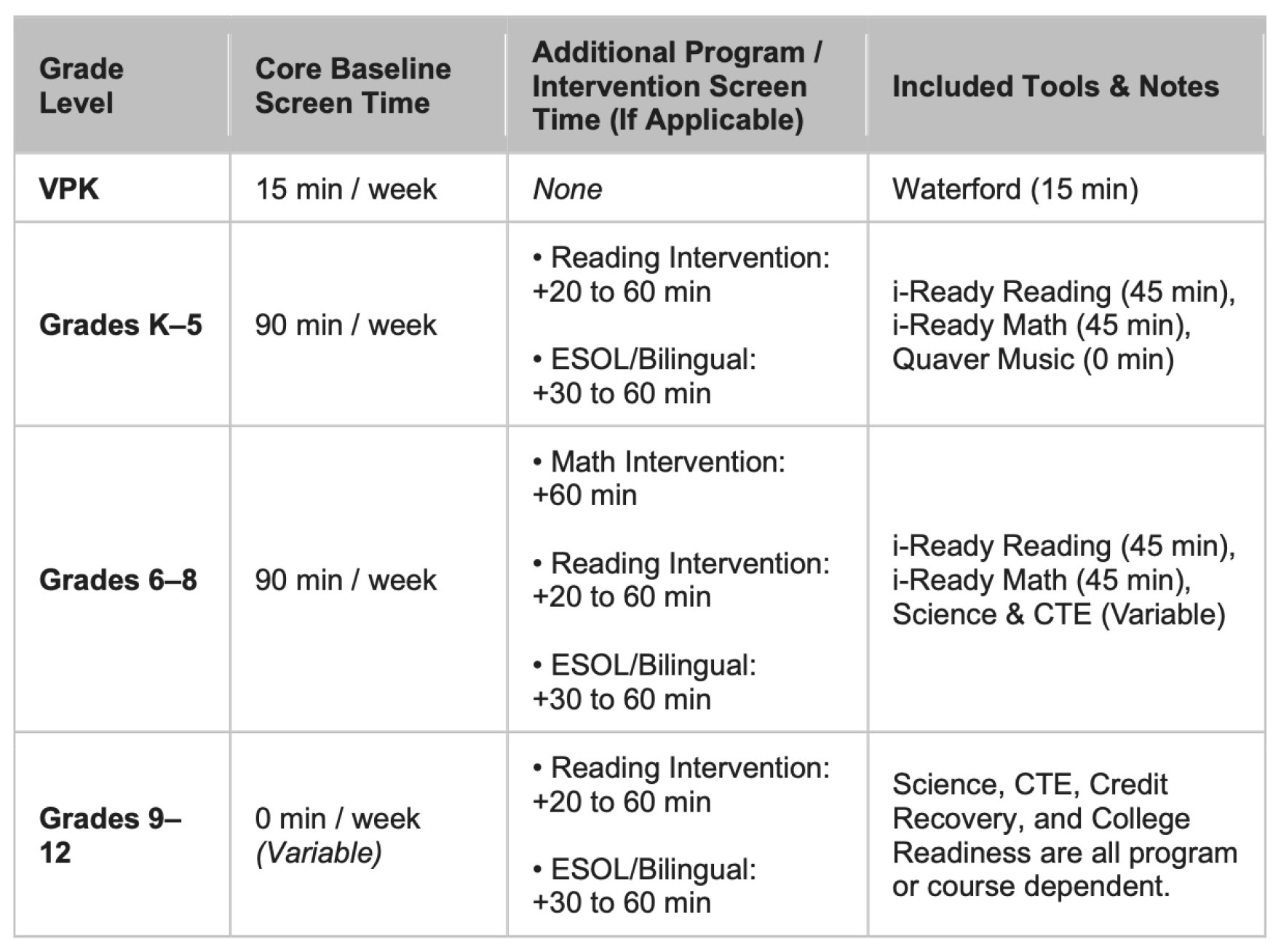
Students enrolled in Miami-Dade elementary and middle schools are expected to spend no more than 90 minutes a week on digital learning platforms in the classroom, according to a district analysis presented Thursday, July 16, at a School Board committee meeting.
The finding gives local families a specific answer to a question that has fueled national debate: How much time are kids actually on screens during instruction?
"I believe that the report really reassures to our parents that Miami-Dade County Public Schools is not replacing our teachers with computers," School Board member Roberto Alonso said at the meeting. "Our students are not sitting in front of a computer all day long."
Alonso requested the analysis in May, asking district staff to examine how much time K-12 students spend on computers during learning. Daniel Mateo, assistant superintendent of schools of choice and parental options, presented the findings.
What the numbers show
The report tracks time students spend on specific digital learning platforms such as i-Ready Reading and Mathematics. Here's the breakdown by grade level:
- Pre-K: 15 minutes per week on literacy and numeracy programs
- K-8: Up to 90 minutes per week
- Grades 6-8 with math intervention: Approximately 2.5 hours per week (the 90-minute baseline plus an extra hour for intervention)
- English-language learners (K-12): 30 minutes to one hour per week for English-support tools
- High school: Varies by course type, with Advanced Placement, Career and Technical Education, and district courses each carrying different expectations
What the report doesn't cover
The analysis has a significant limitation: it measures only time on district-approved digital platforms. A student spending 45 minutes researching and writing an essay on a laptop would not show up in these figures.
Mateo acknowledged the difficulty of tying any single platform to student outcomes. "All of that analysis is strictly correlative," he told the committee. "There is no way to say that a particular platform is 100% tied to performance."
National context
The report arrives amid growing parental anxiety about classroom technology. An April 2026 EdWeek Research Center survey of nearly 600 districts and educators found that 61% of educators say most parents and caregivers feel there is too much technology in schools. A separate question in the same survey found 37% of families consider the amount "just right."
School Board member Monica Colucci acknowledged AI's "wonderful possibilities" at the July 16 meeting but stressed that children need to develop critical thinking skills before relying on such tools.
Mateo emphasized that digital tools supplement classroom teaching. "We know that teacher-driven instruction is the most effective strategy," he said. "These are supplemental tools or enrichment tools that we use to engage students in other ways."
What's next for families
The district is building a parent-facing website with guidance on healthy screen time by age group. No URL has been released.
The first day of school for all M-DCPS students is Thursday, August 13. The district's School Board meeting schedule and agendas are available at dadeschools.net.





.jpg)