New research points to uneven settling in some high-rises along Miami-Dade’s barrier islands, renewing concern about the long-term performance of coastal towers, including those in Sunny Isles Beach.
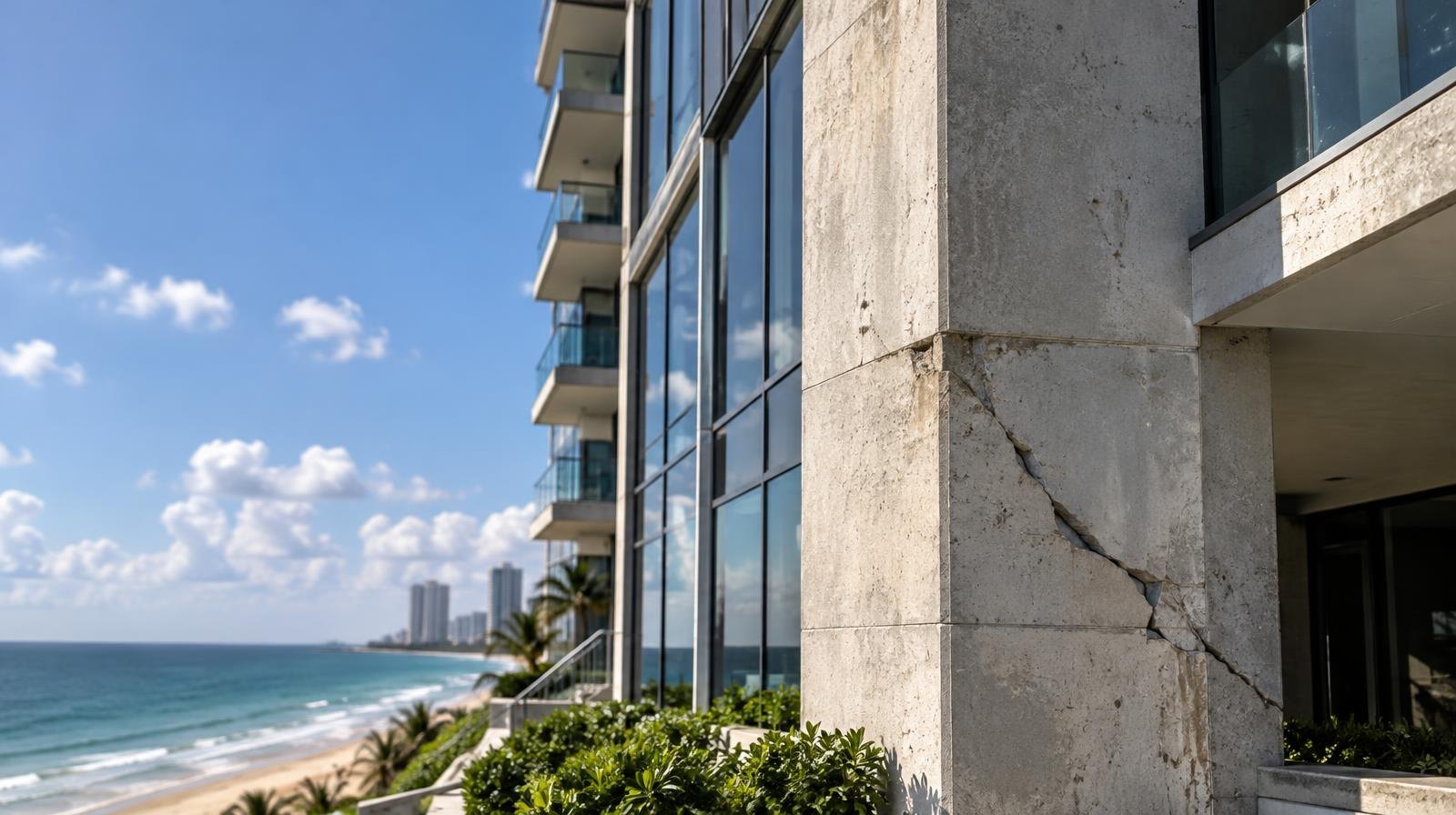
The findings, reported by the Miami Herald, show that parts of individual buildings are sinking faster than others. Engineers call this "differential settlement," and it can lead to cracked facades, misaligned doors, warped floors and twisted rebar.
University of Miami professor Falk Amelung, whose 2024 paper first flagged unexpected sinking in buildings including the Porsche Design Tower and the Faena Hotel, used satellite data tracking multiple points on each structure over time.
Amelung told the Herald that the newer data show differential settlement in some of the 35 buildings identified in the original study. The Herald corrected its report on Oct. 20 to clarify that the finding did not apply to all 35.
The 2024 peer-reviewed study used satellite observations from 2016 through 2023 and documented vertical movement of 2 to 8 centimeters, or about 0.8 to 3.1 inches, affecting 35 buildings and their vicinity. Those measurements of overall sinking are distinct from the newer findings about uneven movement within buildings. The newer detailed findings had not yet been published, according to the Herald’s Oct. 20 report.
What it means for condo owners
The financial exposure falls largely on residents.
Under Florida Statutes section 95.11(3)(b), construction-defect claims generally face a four-year filing period and a seven-year outer deadline, subject to statutory exceptions. For latent defects, the four-year period runs from discovery or when the defect should have been discovered. The seven-year period generally runs from the earliest qualifying occupancy or completion certificate, or abandonment of unfinished construction—not from turnover to an HOA. A 2023 law shortened that outer period from 10 years to seven.
Repair costs from differential settlement can be steep. The Millennium Tower's HOA filed a complaint in 2016 alleging that construction of the neighboring Porsche Design Tower caused cracks in unit ceilings, the lobby marble floor, pool tiles and building columns, the Herald found. The Millennium sued for close to $4 million in repairs. The case settled for an undisclosed amount.
Experts push for monitoring, moratorium
Anil Misra, chair of the civil and environmental engineering department at Florida International University (FIU), said the geology needs closer study.
"This aspect is not understood well, so we need to look at the geology more carefully and make new models of the subsurface and how it is going to settle," Misra told the Herald.
In a paper published May 6, 2026, University of Miami engineer Jean-Pierre Bardet and co-author Jeffrey Dorfman proposed a temporary pause on approvals for slender residential towers exceeding 36 stories while experts develop safety criteria. The authors emphasized that the observations do not indicate imminent structural failure. Their proposal is a recommendation, not an enacted moratorium.
The city of Sunny Isles Beach said in 2025 it had received no reports of damage tied to settling. Mayor Larisa Svechin told the Herald in 2025 that developers in Sunny Isles "work with world-class engineers, often exceeding safety standards." All buildings cited in the study declined to comment to the Herald.
Buildings start installing sensors
At least one Sunny Isles building is already acting on its own. In 2024, the HOA at the Marenas Beach Resort installed a $20,000 wireless sensor system to track subtle structural changes as the 60-floor St. Regis rose next door. The monitoring company, SmartCore, told the Herald that five additional Miami-Dade high-rises have since installed sensors, with six more scheduled by year's end.
In technical findings released in June 2026, the National Institute of Standards and Technology ruled out foundation failure, sinkholes and settling as contributing factors in the 2021 Champlain Towers South collapse in Surfside. The experts cited by the Herald are calling for broader long-term monitoring of coastal towers, beyond the individual systems some buildings have installed.
Amelung told the Herald he hoped to publish more detailed findings within the year; the report did not give a firm publication date.