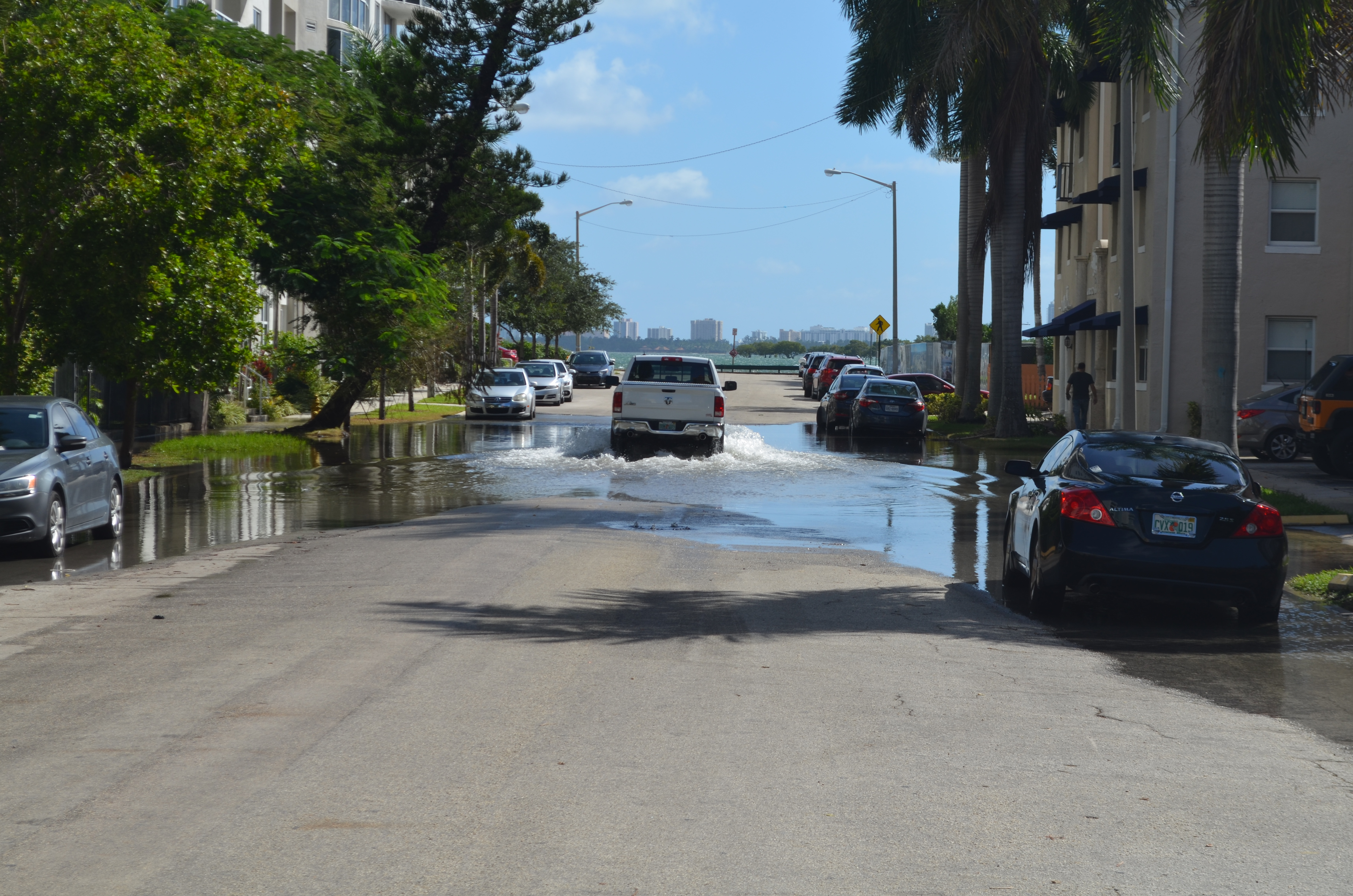
Miami has already recorded 15 days of serious coastal flooding in 2026, 67% above the previous record.
The count, measured by the Virginia Key tidal gauge, could still climb. Two more rounds of king tides are expected before year's end, the Miami Herald reported. The gauge defines "moderate" flooding as water levels about 1.7 feet above the average high tide, a threshold set by the National Weather Service.
For residents along Aventura's Intracoastal Waterway and the Sunny Isles Beach oceanfront, the broader South Florida trend carries real consequences. King tides that once soaked sidewalks every few years are now stalling cars and flooding homes on a more regular basis across the region. The Oct. 27 king tide was the worst in Miami's recorded history, with water levels topping those of some hurricanes and no storm on the horizon.
What scientists are seeing
Tiffany Troxler, director of science at Florida International University's Sea Level Solutions Center, was out sampling the record flooding with Miami-Dade County employees. She has led a group of citizen scientists tracking king tides in South Florida for 11 years.
"That was extraordinary," Troxler said, according to the Herald. "Locations that I'd never seen flood were flooding."
The Herald's analysis found that of the 14 highest tides ever recorded at the Virginia Key gauge, 10 were caused by king tides rather than storms. Eight of those 10 occurred in the last two years.
Jeff Masters, a meteorologist and former hurricane hunter in Miami, said the data point to a sharp acceleration. "It really shows how things are ramping up," Masters said, according to the Herald.
Why it keeps getting worse
Sea level rise is one driver. South Florida has gained about 5 inches of sea level rise since 2005 alone, the Herald reported. But that is not the only factor.
The moon's 18.6-year lunar nodal cycle is entering a phase that pulls tides higher. Scientists said high tides could rise as much as an additional half-foot in the next few years. Masters said the coming decade will bring a sharp increase in tidal flooding as the moon's cycle pushes tides higher.
Under NASA's intermediate-high sea level rise projections, Miami could see 24 days of flooding a year by 2035 and 75 days a year by 2045, the Herald reported. Masters said the Oct. 27 record high tides will seem ordinary by the 2030s.
A federal plan, and its obstacles
A U.S. Army Corps of Engineers project aims to elevate thousands of homes in flood-prone Miami-Dade neighborhoods, including Aventura, Inside Climate News reported. The Corps initially identified 2,057 residences. In August, it added another 2,800 single-family homes and 430 small multifamily buildings.
The project would start in 2032 and could take 15 years. The federal government would cover two-thirds of the estimated $7 billion cost.
Obstacles remain. The Trump administration paused final reports for large-scale home-elevation projects in 2025. Mark Haviland, chief of public affairs for the Corps' Norfolk district, told Inside Climate News the initial focus will be on floodproofing pump stations, wastewater treatment facilities and police and fire stations. The final plan won't be finished until summer 2027, Haviland said.
The public comment period that closed in mid-September drew only 10 written responses. Three came from residents, according to records obtained by Inside Climate News.